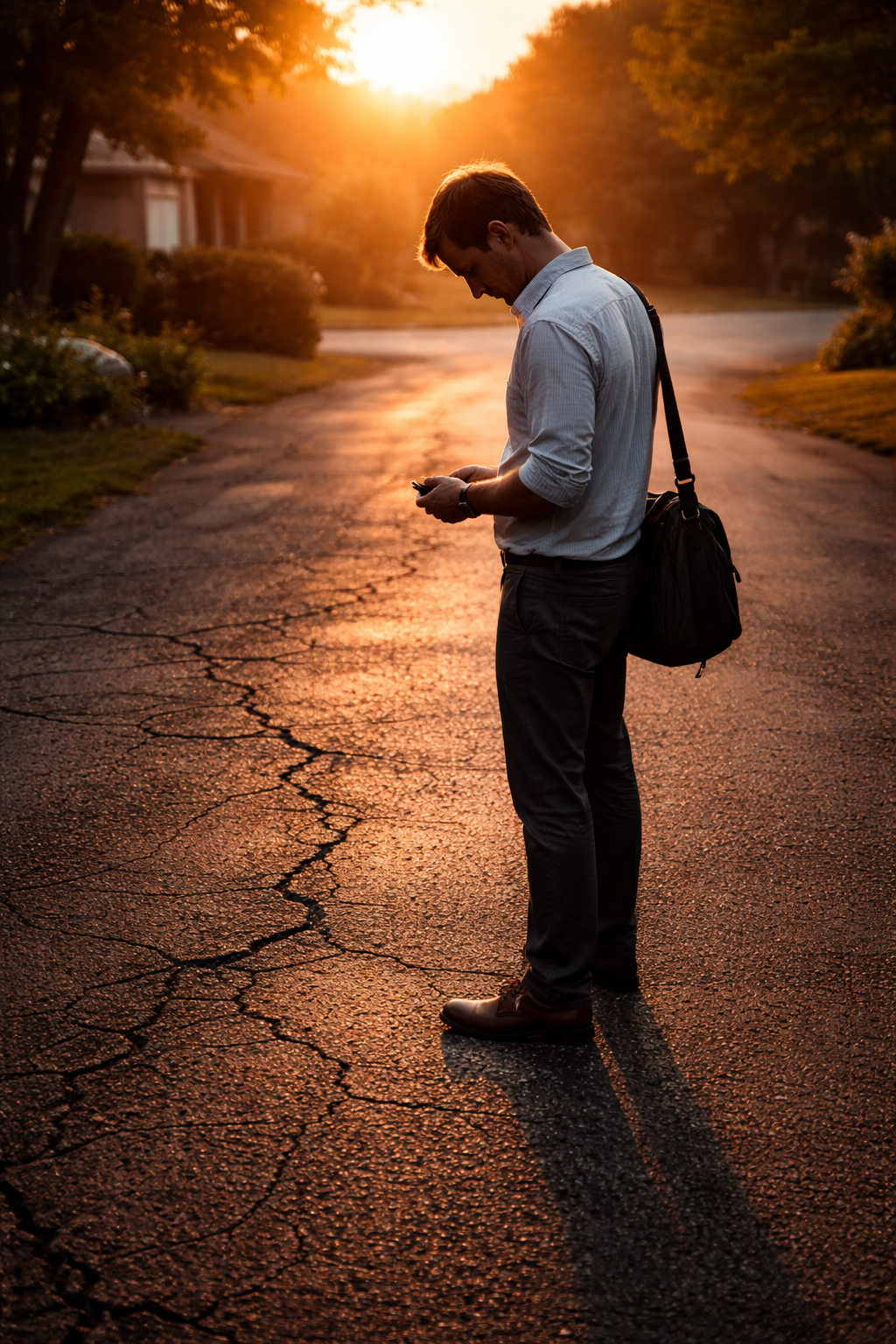
I stared at the cracks in the driveway from the kitchen window while she poured coffee into my Best Boss Ever mug.
The lines in the pavement looked like the slow, uneven spikes of a dying heart monitor.
“We’ve gotta get that fixed,” I said.
“If only we had the money,” she replied, her voice thick with sarcasm.
I didn’t look at her. I took a bite of the rubbery eggs, swallowed without chewing, and chased it with coffee. I pushed the plate away, grabbed my bag, kissed her on the cheek, and left without another word.
I took the same route to work every day. Seven blocks down, left on Bradley, past Finch, until the 34-story building came into view—the one that used to make my father proud.
The only thing I liked about the walk was the taco stand.
Three tacos for five dollars.
I ate one. Threw away two.
The rest of my life, I ignored.
The weight I’d lost.
My wife.
The silence between us.
The way everything felt distant, like I was watching my life instead of living it.
At lunch, I handed over five dollars and my business card.
The guy behind the counter glanced at it, smirked, and tossed it straight into the trash.
Something twisted in my chest.
I took the tacos, walked away, and threw them out without taking a bite. A few minutes later, I walked into a liquor store instead.
On the way back, I held the bottle tight against my side and took a long pull.
That’s when I saw him.
He was digging through a trash can—the same one I’d just used.
I laughed.
“Get a job,” I said.
The words came out easier than they should have.
“Young man?”
I turned.
“It’s fine,” he said to the woman beside him. Then louder, so I could hear:
“He’s just miserable.”
No one had ever said it like that before. Not out loud. Not where I could hear it.
I walked back toward him, anger buzzing through the whiskey in my veins.
“What was that?” I asked.
“You’re the owner of Downey & Sons, right?” he said calmly.
“Looks like you’re the miserable one,” I shot back.
He didn’t react.
“Your father was a good man,” he said.
That stopped me.
“He got me a job. I worked for him. Janitor.”
He paused.
“Then he passed. And you fired me.”
“I don’t remember you,” I snapped. “Don’t talk about my dad.”
But something in my chest had already started to crack.
I don’t remember finishing that day.
I remember drinking.
I remember thinking about my father.
I remember wanting to cry.
When I got home, I collapsed onto the couch and finally did.
She was there—her arms around me, her voice soft, telling me to breathe. I hadn’t heard her like that in a long time.
I think she helped me to bed.
I think she stayed.
I think that was the moment I realized she, my father, and that man were all better than me.
The next morning, she was gone.
A Post-it note sat on the mirror. She’d gone to her brother’s. No timeline. No promises.
I ripped the note down and left the house.
This time, I didn’t avoid the cracks in the driveway.
I walked straight over them.
I drove for hours.
I ended up at my father’s grave.
I sat there, staring at his name, wishing I could undo everything I’d become.
I didn’t go to work for the rest of the week.
On Thursday, I went back to Bradley.
He was there.
Same spot. Same smile.
I bought three tacos.
This time, I didn’t throw them away.
I handed them to him.
“They’re for you,” I said.
“Why are you here?” he asked.
“You’re the only person I can apologize to,” I said.
He nodded, like he already knew.
“What’s in the bag?” I asked, pointing beside him.
“My suit,” he said, smiling wider. “For job interviews.”
That hit harder than anything else.
I made more money than I knew what to do with.
And this man—this man who ate out of trash cans—was still trying.
Still smiling.
Still living.
I looked down at the pavement again.
The cracks were still there.
But they didn’t look like something dying anymore.
“What’s your name?” I asked.
“Miles.”
We sat there for a long time.
He told me stories about my father. About how he used to buy him tacos every day. About how proud he was of me—who he believed I would become.
Not who I was.
“Come in tomorrow,” I said finally, handing him my card. “You’ve got your job back.”
Then I stood up, flagged down a cab, and gave the driver an address I hadn’t said out loud in years.
When I got there, I stood at the door for a long time before knocking.
She opened it.
No makeup. Hair tied up. Still the most beautiful thing I’d ever seen.
“What are you doing here?” she asked.
“I’m sorry,” I said.
And for the first time in six years—
“I love you.”
JMS
((this is part of a book I’m working on))
 Where Love Heals